Spore print black, very dark brown, purplish black, or dark purplish brown, but not fitting the Gomphidiaceae Gills usually light grey, becoming black from spores only when very mature
Psathyrella appears very late in the succession of species on decayed wood. Often, it doesn't appear until the wood has been reduced to powderyhumus
There are many species of Psathyrella, and many still to be discovered. Don't be frustrated if your "Psathyrella" keys out to this point and then no further. That's the state of the art
As it so happens, the photos that we have of Psathyrellas so far are all of unusually robust and colorful ones (no, I'm not joking). Now that we have another reason to take pictures besides aesthetics and personal interest, we'll be documenting more of the bland, uninteresting ones to help you KNOW that the greyish, boring-looking thing growing in your lawn is really a Psathyrella
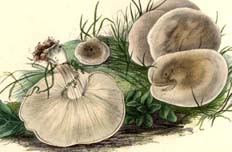
Cap up to 3" across; extremely fragile; pale grey, with brown and distinct but subtle purple tones Capmargin and stalk often hung with shreds of the evanescentpartial veil
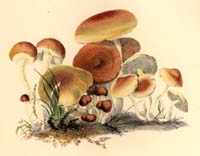
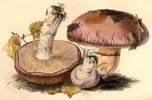
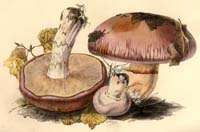
Cap up to 4" across; hemispherical, sometimes umbonate; brown to yellow brown; covered with blackish fibrillose tufts that may wash off in age Gills mottled in age; their edges white, often beaded with drops of moisture when fresh Partial veil a cortina
Stalk often fibrillose (like cap) below the ring, but these wash off in age also