
|
|
|
|
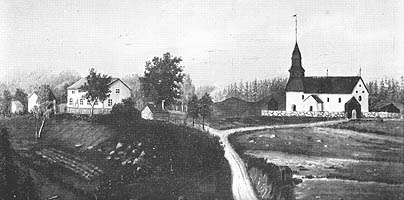 1794 Fries' father was the pastor of the local church, on the right in the image. This is a painting that still hung in the Fries home (on the left in the image) when Theodor Magnus Fries was growing up.
|
|
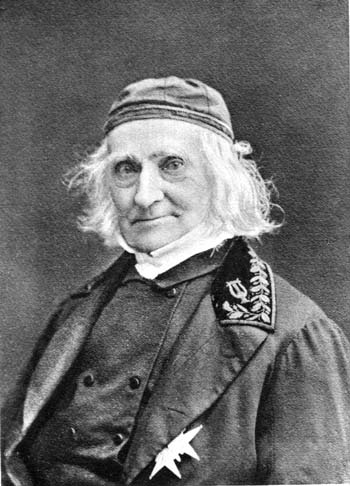 1819 promoted to adjunct faculty.
An only child, Fries was first interested in flowering plants by his father, but at the age of 12 his attention was taken by fungi. Within five years he had a knowledge of more than 300 species, to which he gave names, and on going to Lund he was able to see the works of Persoon and other mycologists and to get the current names for some of his specimens.
Dictionary of the Fungi
Fries was ... a child prodigy who yet in his teens probably knew more about the fleshy fungi than anyone in the world except Persoon.
|
|
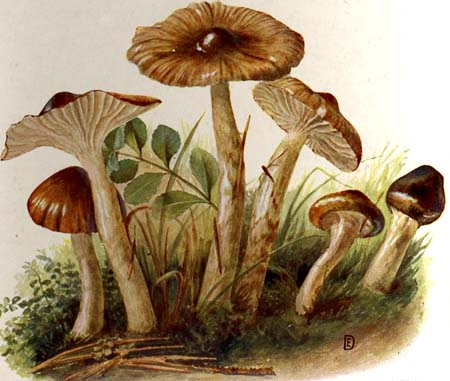 The Dictionary of the Fungi credits Fries with the title "the Linnaeus of Mycology", and this seems a fair title, both in the positive and the negative senses. Like Linnaeus, Fries didn't increase our knowledge of the biology of fungi to a noticeable degree, but he did give us an immeasurably better way to organize that knowledge.
The modern microscope did not exist when he began his work, and, while showing how much can be done without it, he may too long have underrated its value. But he lived to see it confirm many conclusions which his insight foresaw, and solve riddles which he had pondered, but was unable to divine.
|
|
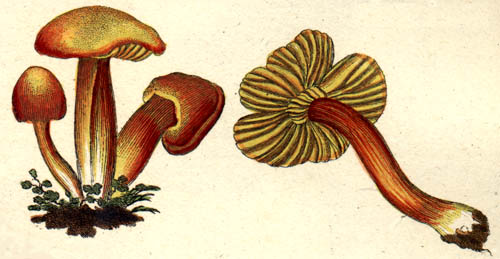 To this I would add that in using spore color as the basis for classifying the gilled mushrooms, Fries was the first to assign taxonomic importance to a (basically) microscopic feature. I believe that in so doing, he gave impetus to the notion of using microscopic features in taxonomy, as he also did with the genus Hygrophorus, the first genus to be segregated on the basis of a microscopic characteristic (its extra-long basidia)
However, the beginner has to know Latin. Apparently, field guides in one's own language had yet to catch on...
 Glossary |  Mushrooms |  |  People |  Newsletter |  Events |